

Lipo 360 and a Brazilian butt lift (BBL) can both reshape the waist-to-hip area, but they solve different problems. Lipo 360 is primarily a fat-reduction and contouring choice: it removes fat around the midsection to change the torso outline. A BBL is a fat-transfer choice: fat is removed with liposuction, prepared and transferred to the buttocks to increase or reshape volume.
That distinction matters more than the procedure name. If your main goal is a smaller or more defined waist without adding buttock volume, Lipo 360 may fit the goal more closely. If your priority is buttock projection or shape, a BBL may be the more relevant discussion, provided you have suitable donor fat and are an appropriate surgical candidate. Some patients may discuss a plan that includes circumferential liposuction and buttock fat transfer, but combining procedures is an individual surgical decision rather than an automatic next step.
For international patients comparing Lipo 360 and BBL in Turkey, the same goal-based decision comes first. Travel, aftercare and follow-up then become additional planning issues; they should not replace the medical question of which operation, if any, fits your anatomy and priorities.
Lipo 360 vs BBL at a glance
Decision point Lipo 360 BBL
Main goal Reduce and reshape fat around the midsection Add or reshape buttock volume using transferred fat
What happens to removed fat Removal is the contouring objective Fat is harvested, processed and transferred to the buttocks
Donor fat requirement No fat-transfer requirement Enough suitable donor fat is needed for the planned transfer
Main visual emphasis Waist, abdomen, flanks and surrounding torso contour Buttock volume, projection and shape, with donor areas also contoured
Recovery distinction Recovery centres on the liposuctioned areas Recovery includes liposuction plus protection of the grafted buttocks from prolonged pressure
Safety decision Liposuction-related surgical risks Liposuction-related risks plus gluteal fat-grafting-specific risks
Can the plans overlap? Yes, circumferential liposuction may be part of a wider body-contouring plan Yes, BBL already requires liposuction to obtain fat; the harvest pattern does not automatically equal Lipo 360
The table is a decision summary, not a substitute for an examination. The useful question is not simply “Which procedure is better?” but “What change am I actually trying to create?”
The main decision: reduce, add, or do both?
The clearest way to separate Lipo 360 from BBL is to identify the direction of change you want.
Choose Lipo 360 as the main discussion when reduction is the priority
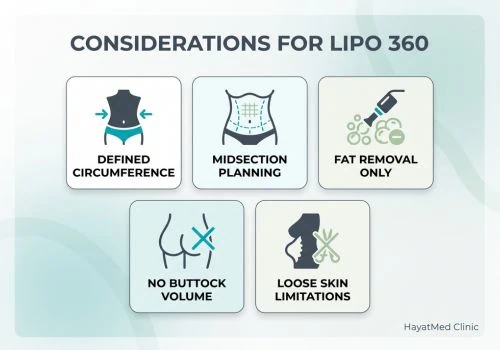
Lipo 360 is most relevant when the dominant concern is excess fat around the torso and the goal is a more defined circumference. In this article, “Lipo 360” refers to liposuction planned around the midsection rather than one isolated pocket of fat. The exact areas still need to be named in the individual surgical plan.
Liposuction removes fat from selected areas; it does not transfer volume to the buttocks. It is also not a substitute for a procedure that removes substantial loose skin. If skin laxity is a major part of the concern, the consultation may need to consider whether liposuction alone can realistically create the intended contour. When a tummy tuck is also being considered, BBL and tummy tuck combinations introduce a separate choice about recovery and surgical scope.
For deeper procedure information rather than a comparison, use HayatMed’s detailed Lipo 360 guide. Broader liposuction questions remain covered in the main liposuction guide.
Consider BBL as the main discussion when added buttock volume is the priority
A BBL uses your own fat for gluteal augmentation. Liposuction is used to harvest fat from donor areas, the harvested material is prepared, and fat is then injected into the buttocks. This makes donor-fat availability part of the treatment decision in a way that it is not for Lipo 360 alone.
A BBL therefore has two contouring components: reducing selected donor areas and adding volume to the buttocks. That does not mean every BBL includes circumferential Lipo 360. The surgeon may choose donor areas according to anatomy, available fat, safety and the proposed result.
The complete BBL guide covers the procedure in greater depth. This comparison stays focused on deciding between the two pathways rather than duplicating that broader BBL information.
A combined plan may be discussed when both changes matter
If the goal is both stronger waist definition and increased buttock volume, it is reasonable to ask whether the surgical plan can address both objectives. Because a BBL already relies on liposuction to harvest fat, circumferential torso liposuction and gluteal fat transfer can be related parts of one body-contouring strategy.
A combined goal does not make a combined operation automatically appropriate. The decision depends on the person’s health, anatomy, donor-fat availability, the proposed surgical scope and the surgeon’s risk assessment. In some cases, the safest or most realistic plan may prioritise one goal or change the scope.
What donor fat changes
Donor fat is one of the most practical differences between the two choices. Lipo 360 can be considered for fat reduction without needing to preserve fat for transfer. BBL requires enough harvestable fat to support the proposed gluteal augmentation.
This affects consultation in two ways. First, a patient who wants a large change in buttock volume may not have enough suitable donor fat for that goal. Second, the areas that make sense for liposuction should be selected for the patient’s overall contour and safety, not simply because more fat is desired for transfer.
The American Society of Plastic Surgeons notes that the amount of available fat, buttock size and shape, skin quality and the patient’s goals all influence the technique selected for buttock augmentation. That is why body assessment matters more than choosing a procedure from photographs or a package label.
Candidacy: factors that can change the plan
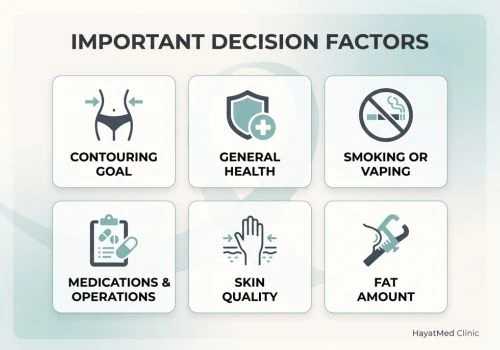
Neither Lipo 360 nor BBL should be chosen from the desired silhouette alone. A consultation needs to evaluate whether surgery is appropriate and whether the proposed scope matches the patient’s health and anatomy.
Important decision factors include:
- your main contouring goal: fat reduction, buttock augmentation, or both;
- general health and medical conditions that may affect anaesthesia, healing or clot risk;
- smoking or vaping and other factors that can impair healing;
- medications, supplements and previous operations;
- skin quality and the degree of skin laxity;
- the distribution and amount of fat available for liposuction;
- for BBL, whether there is enough suitable donor fat for the proposed transfer;
- the amount of surgery being considered in one plan;
- whether your expectations are realistic for your starting anatomy.
These are assessment factors, not a universal eligibility formula. A surgeon should explain why the proposed operation and scope are appropriate for the individual patient.
Recovery: why the practical burden differs
Both choices involve recovery from liposuction. Swelling, bruising, soreness, compression garments and temporary activity limits are common parts of liposuction recovery, although the extent varies with the treated areas and surgical scope.
BBL adds another recovery issue: the transferred fat in the buttocks must be protected from prolonged direct pressure according to the surgeon’s instructions. This can affect sitting, sleeping, work, transport and the practical arrangements needed after surgery. The BBL recovery plan therefore tends to require more attention to positioning than liposuction alone.
This distinction can be important for international patients. A person may be medically suitable for surgery but still need to consider whether they can follow positioning instructions, attend post-operative checks and travel home at an appropriate point in recovery. Exact timelines should come from the operating team because recovery varies by procedure scope and individual healing.
Risks: why BBL adds a separate safety decision
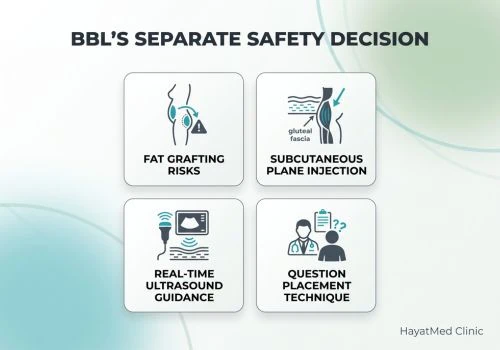
Liposuction is surgery and can involve complications such as infection, fluid collections, contour irregularities or asymmetry, changes in sensation, poor wound healing, anaesthesia complications, deep-vein thrombosis and cardiopulmonary complications. The relevant risks depend on the patient and the extent of surgery.
BBL includes liposuction but also adds gluteal fat grafting. Fat embolism is a rare but potentially fatal complication of gluteal fat grafting, which is why the injection plane is a major safety issue. A joint safety statement from major plastic-surgery organisations supports keeping fat in the subcutaneous plane above the gluteal fascia and supports real-time ultrasound during injection. You can read the joint gluteal fat-grafting safety statement.
Current research supports that direction but does not justify describing any technique as risk-free. A 2026 systematic review found lower complication rates associated with subcutaneous-only injection and ultrasound guidance, while a separate 2026 scoping review concluded that the ultrasound evidence is still mainly observational and non-comparative. In practical terms, ultrasound can be an important safety adjunct, but it is not a guarantee of a complication-free outcome.
That is the comparison-level point this page needs to make. A patient considering BBL should ask specific questions about fat-placement technique and intraoperative imaging, while detailed BBL safety remains a separate subject from the broader Lipo 360-versus-BBL choice.
Comparing Lipo 360 and BBL in Turkey
Choosing Turkey does not change the basic clinical distinction: Lipo 360 is primarily about circumferential fat reduction, while BBL adds fat transfer to change buttock volume or shape. Turkey is a secondary part of this comparison, not the reason to choose one procedure over the other.
For an international patient, travelling for surgery adds practical questions that should be answered before booking:
- Who is the surgeon, and what qualifications and relevant procedure experience can be independently checked?
- In which facility will the operation take place, and what standards apply there?
- If BBL is proposed, what fat-placement plane and ultrasound approach will be used?
- What post-operative reviews are required before departure?
- Who will assess a concern or complication after you return home?
- What symptoms require urgent medical attention, and where should you seek it?
- When does the operating team consider you fit to travel, based on your actual procedure and recovery?
UK patients can also review the current FCDO health advice for Turkey, while patients travelling from other countries should check their own government’s current travel and medical-tourism guidance.
The useful comparison remains narrow: decide first whether you are trying to remove torso fat, add buttock volume, or achieve both. Then evaluate whether the proposed surgical and travel plan can address that goal safely and realistically.
Questions to ask before you decide
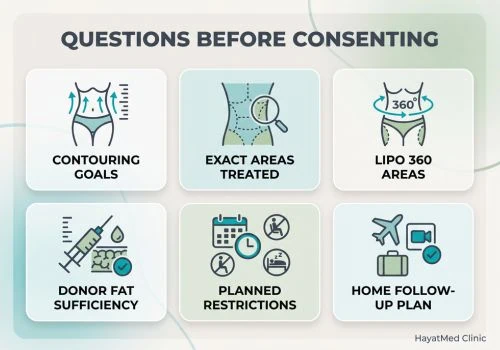
Take a goal-based checklist into the consultation rather than asking only for a procedure by name:
- Is my main goal a smaller or more defined waist, more buttock volume, or both?
- Which exact areas would be treated with liposuction in my proposed plan?
- If you call the plan “Lipo 360”, which areas does that term include for me?
- If BBL is proposed, do I have enough suitable donor fat for the change I want?
- Would combining circumferential liposuction and fat transfer increase the surgical scope in a way that changes my risk or recovery plan?
- If BBL is proposed, where will the fat be placed and how will the injection plane be monitored?
- What sitting, sleeping, compression, work and activity restrictions should I plan for?
- How will follow-up work if I travel home after surgery?
- What result is realistic for my anatomy, and what limitations should I understand before I consent?
A useful consultation should leave you with a clear surgical objective, not just a branded procedure name.
Bottom line
Lipo 360 and BBL overlap because both can involve liposuction, but they are not interchangeable. Lipo 360 is mainly a reduction-and-contouring choice for the torso. BBL is an augmentation choice that uses harvested fat to change buttock volume and shape.
If your priority is waist and midsection definition without added buttock volume, Lipo 360 is the more direct comparison pathway. If buttock augmentation is essential to the goal, BBL is the relevant discussion, assuming donor fat and medical assessment support it. If you want both changes, ask whether a combined plan is appropriate rather than assuming that two procedure names automatically belong together.
For patients considering treatment in Turkey, use the same sequence: define the body-contouring goal first, understand the added recovery and safety considerations of fat transfer, and then assess the surgeon, facility, aftercare and travel plan. The best next step is a consultation that turns your goal into an individual, medically assessed plan.


