
Arm lift cost in Turkey: quick facts for 2026
Typical advertised arm lift surgery prices in Turkey range from €3,400–€4,500 in 2026, while HayatMed’s arm lift starts at €3,300. The operation removes excess upper-arm skin to reshape the contour. Also known as brachioplasty or arm reduction surgery, this procedure addresses a bat-wing (“bingo wings”) appearance caused by ageing, genetics, or weight loss.
At HayatMed, most patients stay 5–7 nights in Istanbul for postoperative checks and fly home once the surgeon confirms that they are fit to travel. Desk work resumes in 10–14 days; heavy lifting around 6 weeks.
Arm lift surgery in Turkey (brachioplasty) reshapes the upper arms by removing loose skin (and sometimes fat) to improve contour, while liposuction on its own addresses fat rather than significant excess skin. It involves permanent scars and does not replace weight loss or muscle-building.
Detail Typical Range / Information
Cost in Turkey €3,400–€4,500 (general comparison range)
HayatMed starting price €3,300
Surgery Duration 1.5 – 3 hours
Hospital Stay 1 night
Typical HayatMed stay in Istanbul 5–7 nights; flight after surgeon clearance
Return to Desk Work 10 – 14 days
Full Activity Clearance 6 – 8 weeks
Why Turkey for brachioplasty
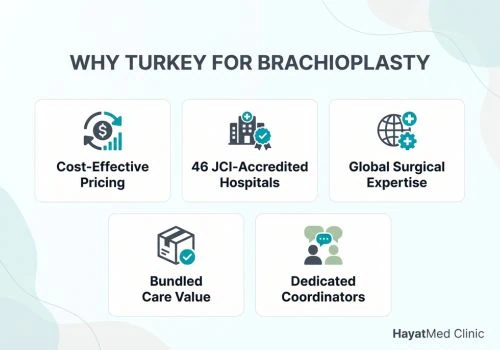
Turkey attracts international patients through its cost-effective pricing and surgical expertise within the country’s expanding plastic surgery sector. As of 2026, 46 JCI-accredited institutions operate in Turkey, with 29 located in Istanbul. Accreditation audits specify quality systems but do not guarantee an individual surgical outcome.
Turkish plastic surgeons handle substantial case volumes as part of global procedure growth tracked by ISAPS. Many complete their training at European and American institutions before practising in Turkey.
This experience, paired with lower operational costs, creates value for international patients. Bundled care models and lower operational costs can reduce overall pricing compared with the UK or US, depending on the provider and what is included.
At HayatMed, licensed surgeons perform arm lifts at JCI-accredited partner hospitals in Istanbul, assigned according to the care plan. Dedicated international patient coordinators oversee every stage, from consultation through postoperative follow-up.
Who benefits from arm lift surgery?
Ideal candidates present with noticeable skin laxity that hasn’t improved with exercise or diet. In consultation with a qualified plastic surgeon, you’ll discuss whether you are at a stable weight and how factors such as BMI (often around 30 or below) may affect risk and planning.
You may benefit if you
- Have excess arm skin following major weight loss or bariatric surgery
- Experience skin laxity from ageing or genetic factors
- Maintain a stable weight for at least six months
- Don’t smoke or can quit four weeks before and after surgery
- Are in good overall health without healing impairments
- Hold realistic expectations about scarring and final appearance
Medical conditions requiring evaluation include:
- uncontrolled diabetes
- blood-clotting disorders
- active infections.
We conduct thorough preoperative assessments to identify factors that affect candidacy and inform surgical planning.
Brachioplasty techniques: mini, standard, extended
1. Mini arm lift (also called minimal incision upper arm lift) addresses mild laxity near the underarm with a shorter incision confined to the armpit area. Surgical incision patterns are discussed in the brachioplasty overview and techniques.
Recovery may be shorter, with a smaller scar than a full-length incision, although results vary. This is suitable for patients with good skin elasticity and limited excess tissue.
2. Standard brachioplasty addresses moderate to significant skin excess through an incision extending from the armpit to the elbow along the inner arm. This technique removes substantial tissue and tightens underlying structures for comprehensive reshaping.
3. An extended arm lift addresses severe laxity that extends onto the chest wall, which is common after massive weight loss. The incision pattern enables broader tissue removal, resulting in harmonious contours across adjacent areas.
4. Liposuction-assisted arm lift combines fat removal with skin excision when both contribute to arm appearance. The surgeon selects the technique after assessing fat distribution, skin laxity and the treatment plan.
Arm liposuction versus an arm lift
Arm liposuction can reduce localised fat when skin elasticity is adequate, but it does not remove substantial loose skin. An arm lift excises excess skin and may include liposuction when both fat and laxity need treatment. The choice depends on:
- a surgeon’s examination
- scarring trade-offs
- realistic contour goals.
What happens during arm lift surgery
Your procedure takes place under general anaesthesia at a JCI-accredited partner hospital in Istanbul. Duration ranges from 1.5 to 3 hours, depending on technique complexity.
Surgical steps
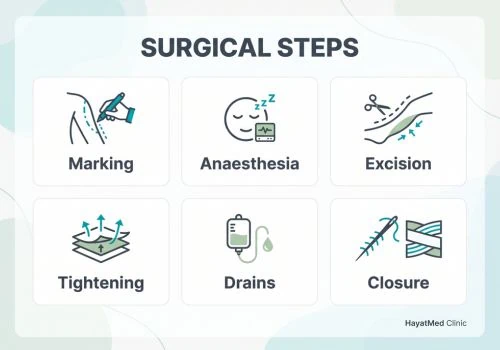
- Marking: Surgeon marks incision lines while you stand for optimal positioning
- Anaesthesia: General anaesthesia keeps you asleep during the procedure while the anaesthesia team monitors you
- Excision: Precise removal of excess skin and fat while preserving nerves and vessels
- Tightening: Underlying tissue repositioned and secured for enhanced definition
- Drains: Small tubes may be placed to drain fluid when your surgeon considers them necessary
- Closure: Meticulous suturing followed by compression garment application
At HayatMed, most patients stay 1 night in hospital for observation; your surgeon confirms the individual plan. When drains are needed, they typically remain in place for three to five days. They are removed at follow-up once drainage has decreased sufficiently.
Recovery timeline after arm lift
Understanding healing phases helps you plan time away from work and daily responsibilities. Typical arm lift recovery expectations include a gradual return to activities over several weeks. Desk work usually resumes within 10–14 days, while upper-body training begins approximately 6 weeks later.
Recovery Milestone Timeline Key Activity / Notes
Pain and medication review First 7–10 days Your clinician decides which pain medicines, doses and changes are appropriate
Drain Removal 3–5 days Typically done at a follow-up appointment
Peak Swelling 3–5 days Keep arms elevated above heart level to manage
Driving Resumes 7–10 days (typical; surgeon clearance required) Resume only when movement and prescribed medicines do not impair safe driving
Desk Work 10–14 days Light tasks only; avoid any heavy lifting
Light Stretching 3 weeks Begin gentle range-of-motion exercises
Full Upper-Body Training 6–8 weeks Requires final clearance from your surgeon
Visible swelling may persist for up to one month, gradually diminishing as healing progresses. At HayatMed, compression garments are typically worn for about 6 weeks to support healing; your surgeon confirms the fit and duration for you.
You’ll need assistance with household tasks for at least one week. We schedule remote photo reviews for weeks 1 and 4.
Flying home after brachioplasty in Turkey
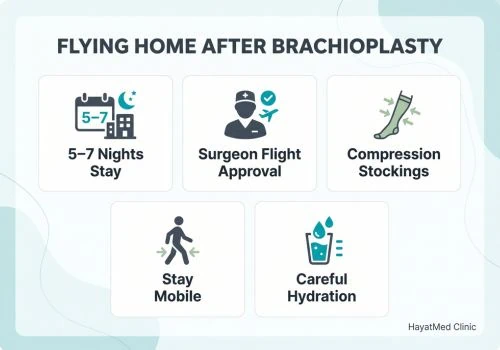
At HayatMed, most patients stay 5–7 nights in Istanbul and fly home only after their surgeon confirms that healing permits safe travel. This allows time for:
- drain removal
- initial healing assessment
- confirmation that no complications have developed.
Long-haul travellers should:
- wear compression stockings
- perform regular calf exercises
- walk the cabin every hour on flights exceeding four hours.
Clots are uncommon but serious. This risk is often described as deep vein thrombosis (DVT), a blood clot that can form in the leg veins after surgery and long travel.
Prevention includes:
- compression
- early mobilisation
- careful hydration
- medication where indicated based on major hospital thrombosis-prevention protocols.
Standard travel insurance policies typically exclude elective cosmetic procedures and related complications. We recommend purchasing specialist medical tourism insurance covering post-surgical complications. Our patient coordinators provide fit-to-fly assessment documentation and guidance on insurance options before travel.
Arm lift risks and complication rates
All surgery carries inherent risks. Awareness helps you make informed decisions and recognise warning signs requiring medical attention. In suitable candidates treated at accredited centres, minor issues are uncommon.
Common temporary effects
- Swelling and bruising lasting 2–3 weeks
- Numbness along incision sites persists for weeks to months
- Mild to moderate discomfort managed with medication
- Limited arm mobility during the first 1–2 weeks
Potential complications
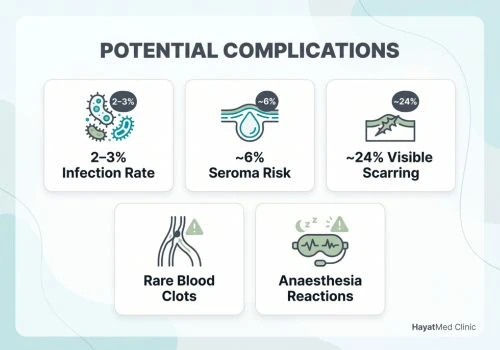
Infection rates are often quoted at about 2–3% following brachioplasty; individual risk varies with medical history, technique and postoperative care. Fluid buildup after an arm lift sometimes requires drainage. This is often called a seroma (a pocket of fluid under the skin) and may require drainage if it becomes persistent or uncomfortable.
It affects approximately 6% of patients, with ranges varying by technique and patient factors, according to a meta-analysis of complication rates. Techniques such as progressive tension sutures, selective drains, and early walking help reduce the occurrence.
Hypertrophic scarring affects approximately 24% of patients undergoing brachioplasty. Scar maturation typically takes 12–18 months, and proper management reduces visibility over time. Rare but serious complications include:
- blood clots
- anaesthesia reactions
- compartment syndrome.
We provide detailed warning signs and emergency contact information as part of discharge instructions. Choosing an experienced surgeon at a JCI-accredited facility may reduce risk, but it cannot eliminate complications. Our team maintains strict sterile protocols and closely monitors patients throughout recovery.
Arm lift scarring: placement and aftercare
Incisions result in permanent scars; however, strategic placement and diligent care can significantly impact the final appearance. Your surgeon positions incisions along the inner arm where they remain concealed when arms hang naturally. Scars typically fade significantly over 12–18 months, transitioning from red or pink to lighter tones that blend with surrounding skin.
Scar care strategies
- If your treating team recommends silicone sheets or gel, use them as directed, often over 3–6 months
- Massage scars gently once incisions fully close at week 3–4
- Protect from sun exposure with SPF 50+ or covered clothing for one year
- Attend follow-up appointments for professional assessment
- Consider laser therapy for particularly prominent scars after six months
Most patients find that scars become minimally noticeable once fully matured. Initial redness gradually fades, though complete invisibility isn’t achievable with current surgical techniques.
Arm lift cost in Turkey: what’s included
Our arm lift packages provide transparent pricing with comprehensive inclusions, simplifying financial planning for international patients. The Turkey and international comparisons below are indicative market figures; HayatMed’s individual written quote is based on the treatment plan.
The package typically includes
- Surgeon fees and expertise
- General anaesthesia services
- Operating theatre costs
- One-night hospital accommodation
- Compression garments (two sets)
- Private airport, hospital and hotel transfers
- Initial follow-up appointments (first 10 days) and scheduled doctor examinations
- Preoperative testing and diagnostics
- Postoperative medication included in the care plan
- 5 hotel nights
- English-speaking personal assistant
- 12 months of remote follow-up with the treating team and 24/7 on-call support
Additional expenses to budget
- International flights (not included in package)
- Extended hotel stays beyond the package (if desired)
- Meals and personal expenses during stay
- Travel insurance covering elective surgery
- Additional prescriptions beyond the postoperative medication included in the confirmed package, if needed
Country Price Range What’s Typically Included
Turkey €2,400 – €3,500 Hospital, anaesthesia, garments, transfers, follow-ups
United Kingdom £6,000 – £9,000 Surgery only; hospital and aftercare often separate
United States $8,000 – $12,000 Surgery only; facility fees typically additional
Australia AUD 10,000 – 15,000 Surgery only; anaesthesia and hospital often separate
We provide detailed written quotes during consultation, clearly outlining every included service. Final costs are confirmed in writing before booking; if clinical needs change the plan, any cost impact is explained and agreed in advance. Many patients find the total investment, including travel, can be lower than UK or US pricing, depending on the provider, inclusions, and individual clinical needs.
Treatment planning should begin with an in-person assessment and any investigations the clinician considers necessary. Based on your goals, anatomy, medical history, and risk factors, the team explains whether the procedure is appropriate and outlines the steps, expected timeline, and aftercare plan.
Procedures should be carried out in licensed clinical settings with documented infection-control processes and clear escalation pathways for complications. Before you confirm, ask who will perform each step, what monitoring is used, and how follow-up is handled once you return home.
A reliable quote itemises what is included and what is optional, for example:
- consultations
- tests or imaging where relevant
- medications
- accommodation
- transfers
- follow-up.
This helps you compare like-for-like, because package inclusions and aftercare policies can vary between providers.
Combining procedures for body contouring
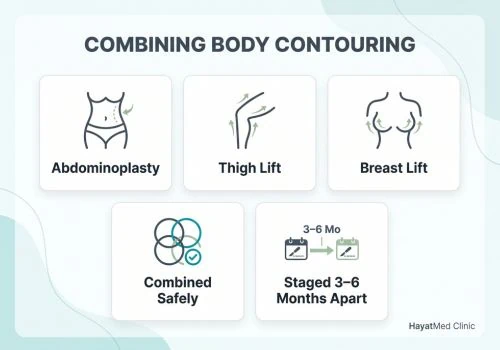
Patients addressing multiple concerns after significant weight loss may combine brachioplasty with complementary body contouring. Common combinations include an arm lift with:
- abdominoplasty
- a thigh lift
- a breast lift.
Current speciality guidance indicates multiple procedures can be combined safely when total operating time remains within prudent limits and patient factors are favourable.
Our surgical team prioritises safety above efficiency. Some patients benefit from staged surgeries spaced several months apart, particularly when extensive contouring across multiple regions is planned. Staging two sessions three to six months apart is common for:
- higher-BMI cases
- those with prior major surgeries
- those undergoing complex reconstruction.
We assess your overall health, specific concerns, and aesthetic goals to recommend the safest approach. Combined procedures increase both surgical fees and recovery demands. We openly discuss trade-offs during consultations, ensuring you understand implications before making decisions.
How long do arm lift results last?
Arm lift surgery offers lasting improvement when you maintain a stable weight. Removed skin does not grow back, but remaining skin can stretch or relax with weight changes and ageing.
However, significant weight fluctuations can alter the shape of the arms. Maintaining weight stability and healthy lifestyle habits preserves arm contours for many years.
We recommend establishing stable eating habits and engaging in regular exercise before surgery. Resistance training targeting the biceps and triceps enhances muscle definition beneath tightened skin after you’re cleared for full activity, typically around 6–8 weeks.
Ageing continues naturally post-brachioplasty. Gradual skin relaxation over many years is a normal process.
Sun protection, adequate hydration, and proper nutrition support skin health and may slow age-related changes. Satisfaction lasting ten to fifteen years or longer is often quoted for patients who maintain weight within 5kg of their surgical weight, but individual changes in skin and expectations mean there is no guaranteed duration.
Choosing an arm lift surgeon in Turkey
Quality and safety should guide the selection of providers when considering treatment abroad. Confirm the surgeon holds plastic surgery speciality training and verify the hospital holds JCI accreditation. Check the surgeon’s membership in ISAPS or equivalent professional bodies.
Key verification steps
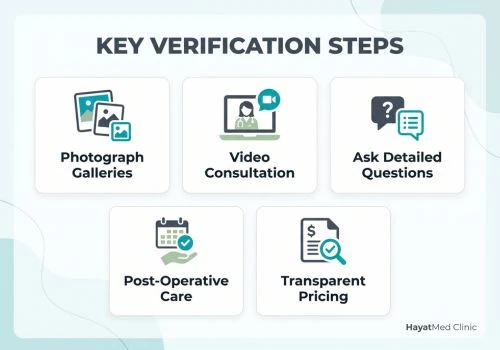
- Review before-and-after photograph galleries showing actual patient results
- Assess communication clarity and comfort during video consultation
- Ask detailed questions about surgical techniques and complication rates
- Evaluate post-operative care protocols and follow-up availability
- Verify transparent pricing with no hidden fees
Reputable providers offer transparent information and realistic expectations rather than unrealistic promises. At HayatMed, the surgical team works at JCI-accredited partner hospitals in Istanbul. We provide honest assessments during consultation, clearly explaining what brachioplasty can and cannot achieve for your specific anatomy.


A tummy tuck revision is a secondary procedure considered after a previous abdominoplasty when a persistent contour or scar concern

A tummy tuck (abdominoplasty) can produce results that last ten years or longer. The skin and fat removed during surgery

A mini tummy tuck removes excess skin below the belly button and tightens the lower abdominal muscles, typically costing £2,200–£3,500