

Alarplasty, or alar base reduction, is a focused operation that narrows or reshapes the nostril base. It may suit someone whose main concern is alar flare, a broad nasal base, large nostril openings or selected asymmetry, without needing the bridge or tip changed. It can be performed alone or alongside broader rhinoplasty.
The trade-off is that narrowing is achieved around the nostril base, so scar placement, symmetry and preservation of the external nasal airway must be planned conservatively. For international patients considering alarplasty in Turkey, the same anatomy-led assessment matters before travel; destination does not change the need for an individual surgical plan.
What Is Alarplasty and What Can It Change?
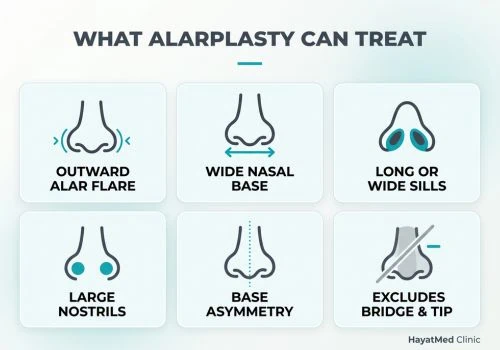
The alae are the curved outer walls of the nostrils. The nasal base also includes the nostril sills, the tissue forming the floor of each nostril opening. Alarplasty changes this lower part of the nose rather than automatically reshaping the whole nasal framework.
A 2022 clinical review of alar base reduction describes common reasons for alar-base modification as a wide nasal base, excessive alar flare, large nostril size and asymmetry. The exact target matters because “wide nostrils” can describe different anatomical problems.
Alarplasty may be used to address:
- outward alar flare;
- excessive width across the nostril base;
- a long or wide nostril sill;
- large nostril openings where narrowing is anatomically appropriate;
- selected asymmetry of the nostril base or alae.
It does not, by itself, remove a bridge hump, straighten the bony nose or reshape a bulbous or drooping nasal tip. Those concerns belong to broader rhinoplasty or a more specific nasal procedure.
Who May Be a Candidate for Alar Base Reduction?
A useful candidate assessment starts with the location of the concern, not with the procedure name. Alarplasty is most relevant when the nasal base or nostril width is the organising concern and the desired change can be achieved without treating the bridge or tip as the primary target.
Assessment should consider:
- whether the concern is true base width, alar flare, nostril sill width, asymmetry or a combination;
- how the nostrils look from the front and base views rather than from one photograph alone;
- whether narrowing could compromise the external nasal airway;
- existing asymmetry and the limits of making two nostrils look identical;
- scar characteristics and the acceptability of an incision around the nostril base;
- previous nasal surgery or trauma;
- whether the patient is actually asking for a tip, bridge or whole-nose change.
If you have already had rhinoplasty, the decision belongs in a revision rhinoplasty assessment rather than being treated as a routine first-time alarplasty decision.
Alarplasty vs Tip Plasty vs Full Rhinoplasty
These procedures can overlap in one treatment plan, but they answer different primary questions.
Main concern Procedure or decision usually being assessed What it does not automatically address
Wide nostril base or excessive alar flare Alarplasty / alar base reduction Bridge shape or nasal-tip structure
Tip width, projection, drooping or tip definition Tip plasty Nostril-base width unless a separate alar procedure is added
Multiple areas of the nose, overall proportion or structural reshaping Full rhinoplasty It does not mean every patient needs alar-base excision
A concern after previous nasal surgery Revision assessment It should not be assumed to be the same plan as primary surgery
Breathing obstruction Functional nasal assessment Cosmetic narrowing should not be assumed to treat obstruction
The distinction helps you decide whether your concern is limited to the nostril base or needs a broader rhinoplasty assessment. If your main concern is the tip rather than the nostril base, the decision should stay with tip-focused assessment.
How Alar Base Reduction Is Planned
There is no single alarplasty technique that fits every wide or flared nasal base. The technique is selected according to the anatomical component that needs changing and how much narrowing can be achieved without distorting the nostril.
Alar Wedge Reduction
An alar wedge excision removes tissue from the outer alar region, usually where the nostril wing meets the cheek. In the clinical literature, this approach is used mainly for excessive flare or an enlarged alar lobule.
The purpose is not simply to “make the nostril smaller.” The surgeon has to judge how changing the outer alar contour will affect the crease, nostril outline and overall nasal-base shape.
Nostril Sill Reduction
A sill excision removes tissue from the floor of the nostril. It is used when the problem is more closely related to base width, interalar distance or nostril-sill length.
Because flare and base width are not the same anatomical problem, a sill approach may be more relevant in one patient while an outer alar approach is more relevant in another.
Combined Reduction
Some patients have both a wide base and significant alar flare. A combined approach can address both components. The 2022 review describes wedge, sill and combined excisions as the three basic excisional patterns, but the amount and exact placement remain anatomy-specific.
Patients do not need to choose a named excision before assessment. The more useful question is which part of the nasal base needs to change, how much change is reasonable and what trade-offs come with that plan.
Scars, Symmetry and Functional Trade-Offs
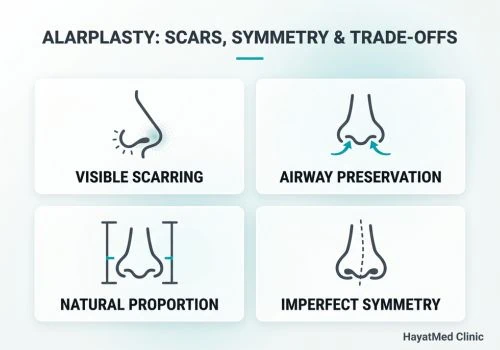
Alarplasty involves incisions around the nostril base, so a scar is part of the procedure rather than something that can be promised away. Incisions may be positioned in or near the alar-facial groove, at the nostril sill, or in both areas depending on the technique.
Published scar studies show that many scars can become unobtrusive, but visibility varies. A scar-outcome cohort found generally favourable patient-rated scar appearance with two incision placements, while an older long-term series reported that some patients later had dermabrasion for noticeable scars. These are cohort findings, not a guarantee for an individual patient.
The functional trade-off also matters. A review of conservative alar-base planning warns that excessive narrowing can contribute to complications such as nasal stenosis. Another treatment-algorithm study describes nostril distortion or stenosis when resection extends too far into the vestibule.
For that reason, a safe plan should prioritise proportion and airway preservation rather than the smallest possible nostril. Perfect symmetry should not be promised because natural nasal anatomy is rarely perfectly symmetrical before surgery and healing can also differ between sides.
What to Expect From Healing and Recovery
Standalone alarplasty and full rhinoplasty should not be given the same recovery timetable. Alarplasty-specific healing centres on the nostril-base incisions and the tissues that were narrowed, while a full rhinoplasty may also involve bone, cartilage, the septum or nasal-tip work.
Published alar-base series assess scar appearance during follow-up rather than supporting a promise that an early incision appearance is final. The literature also does not establish one universal return-to-work date, suture-removal day or activity schedule that applies to every alarplasty technique and patient.
Your surgeon should therefore give the operative wound-care and activity plan for the technique actually used. If alarplasty is performed as part of a larger nose operation, the broader rhinoplasty recovery plan becomes relevant because the more extensive procedure usually controls the restrictions.
During follow-up, the useful questions are whether the incisions are healing appropriately, whether the nostril shape is settling without problematic narrowing, and whether any breathing change needs clinical review.
What Alarplasty Can and Cannot Promise
Alarplasty can create a narrower or less flared nasal base when the anatomy supports that goal. It cannot guarantee perfectly matched nostrils, an invisible scar, a specific millimetre change or a particular cosmetic outcome.
The result also needs to be judged in relation to the rest of the nose and face. Making the base narrower does not automatically improve a bridge, tip or profile concern. In some patients, treating only the base would leave the main concern unchanged; in others, adding a larger rhinoplasty would be unnecessary.
A good assessment should therefore define the smallest procedure that addresses the actual problem without taking on changes the patient did not request.
Planning Alarplasty as an International Patient

For an international patient, the treatment decision comes before the travel plan. The key questions are whether the concern is truly alar-base specific, whether standalone alarplasty is enough, what scar and airway trade-offs apply, and how follow-up will work after returning home.
HayatMed currently offers standalone alarplasty as a service, but the technique, surgeon assignment, recovery instructions, package and price must be confirmed for the individual case rather than assumed from the procedure name.
For general provider due diligence, the HayatMed guide to choosing a rhinoplasty surgeon covers qualifications, relevant experience, facility standards, aftercare and quote comparison. Choosing a provider is a separate decision from deciding whether alarplasty is appropriate for your nasal-base concern.
Preparing for an Alarplasty Assessment With HayatMed
HayatMed’s current rhinoplasty consultation information states that the team can review photographs and medical history, discuss your goals and provide a detailed quotation. The current free consultation form also lets you identify the treatment you are considering and provide your contact details.
For an alarplasty discussion, prepare the photographs and medical history requested for review and describe the specific feature that concerns you, such as nostril-base width, flare or asymmetry. Include any previous nasal surgery and mention breathing symptoms rather than assuming they are cosmetic.
HayatMed can use that information to clarify whether the question appears limited to the alar base, whether a broader rhinoplasty assessment is needed and what additional information is required before treatment planning. A remote review is preliminary; final suitability and the operative plan may change after direct clinical examination.


