
Dental veneers in Turkey may be an option for adults who want to change the appearance of suitable teeth, but the decision should start with diagnosis rather than price or travel plans. Veneers are custom-made coverings placed over the front surface of teeth. Because placement commonly involves removing some enamel, treatment is generally irreversible and should be planned by a qualified dentist after checking the teeth, gums and bite.
For an international patient, a useful decision is not simply whether veneers are available in Turkey. It is whether veneers are appropriate for your teeth, which material and preparation approach is reasonable, what risks and alternatives you understand, and how examination, fitting and follow-up will work when treatment takes place away from home.
Are veneers in Turkey right for you?
Veneers are mainly a cosmetic treatment. They can change the visible colour, shape and proportions of teeth and can mask some chips, gaps or mild irregularities. They do not replace diagnosis or treatment for active dental disease.
A dentist needs to assess the condition of each tooth, the health of your gums, your bite, any clenching or grinding, previous dental work and the result you want. Decay or gum disease should be treated before veneers are placed. People who grind their teeth or have a deep overbite may be less suitable for veneers, and some patients will be better served by another treatment.
For a fuller explanation of what veneers are and the main types, see HayatMed’s what are dental veneers guide.
What can dental veneers change?
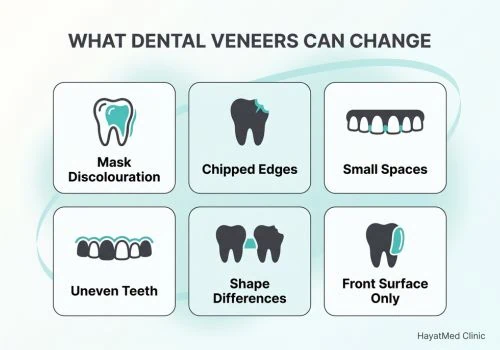
Veneers can be considered when the main concern is the appearance of the front surface of a tooth. Depending on the clinical situation, they may help mask:
- discolouration that is not being managed adequately with simpler cosmetic options;
- chipped or broken edges;
- small spaces between teeth;
- teeth that look uneven, misshapen or mildly crooked;
- differences in visible tooth shape or proportion.
The important limit is that veneers cover the front surface of a tooth; they are not a universal solution for damaged or unhealthy teeth. If a tooth needs more extensive structural coverage, a dentist may discuss another restoration.
Who may be suitable for veneers?
A suitable veneer candidate generally needs teeth and gums healthy enough for elective cosmetic treatment and enough sound tooth structure for the planned bonding approach. The patient also needs realistic expectations about colour, shape, symmetry and the fact that future maintenance or replacement may be necessary.
Before agreeing to treatment, the dentist should know about active dental problems, previous restorations, grinding or clenching, bite concerns and the changes you want to achieve. Suitability cannot be decided reliably from a price list or smile photograph alone.
When might veneers not be the best first option?
Veneers may be inappropriate or premature when tooth decay or gum disease is active, when the bite creates excessive stress, or when grinding is likely to overload the restorations. They may also be a poor first choice if the desired change can be achieved with a less invasive treatment.
The key question is how much healthy tooth structure must be altered to reach the cosmetic goal. Because enamel removal for veneers is not reversible, patients should understand whether a more conservative alternative is reasonable before committing to preparation.
Porcelain or composite veneers: what is the practical difference?
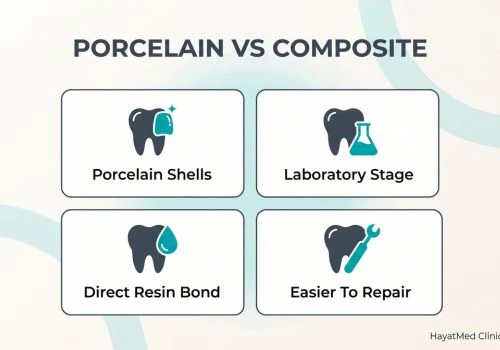
The two main veneer categories are porcelain and composite. The best choice depends on the tooth, the cosmetic goal, the amount of preparation required and how the material is expected to behave in that patient’s mouth.
Porcelain veneers are custom-made shells. They are generally strong, natural-looking and more resistant to staining and wear than composite. They usually involve a laboratory stage before final bonding.
Composite veneers use tooth-coloured resin bonded directly to the tooth. They may require less enamel removal and fewer visits in some cases, and they can be easier to repair if damaged. They are generally less resistant to staining and wear than porcelain.
Material names should not replace clinical planning. A dentist should explain why a specific material is being recommended for your teeth rather than treating a brand or ceramic label as a guarantee of a better result. For subtype detail, use HayatMed’s composite veneers guide and porcelain veneers guide.
What happens during veneer treatment?
The exact sequence depends on the material and case, but the broad pathway should remain diagnosis-led.
- Assessment and planning. The dentist evaluates the teeth, gums, bite, previous dental work and cosmetic goals and treats relevant dental disease first.
- Shade and design decisions. The planned colour, shape and number of treated teeth are discussed before irreversible preparation.
- Tooth preparation and records. For porcelain veneers, a small amount of enamel may be removed, followed by an impression or digital scan. A temporary restoration may be used while the veneer is made.
- Fit and bonding. The dentist checks the veneer’s fit and shape, makes necessary adjustments and bonds it to the tooth.
- Review. The bite and comfort should be checked, and the patient should understand care and follow-up.
Composite veneers follow a different workflow because tooth-coloured resin is bonded and shaped directly on the tooth. For the detailed procedure rather than this overview, see HayatMed’s how veneers are done guide.
What risks and trade-offs should you understand?
The most important trade-off is irreversibility. Enamel is commonly removed to place a veneer, so the tooth is permanently changed. A veneer can also chip, crack, wear, loosen or need repair or replacement over time.
Treatment on unhealthy teeth can worsen existing problems, which is why decay and gum disease should be addressed first. Grinding, clenching and certain bite relationships can also make veneer treatment less suitable.
Cosmetic expectations matter as well. A technically sound veneer can still be disappointing if the planned shape, shade or degree of tooth preparation was not understood before treatment. Consent should therefore include the proposed preparation, alternatives, material choice, expected appearance, foreseeable risks and what happens if adjustment or further care is needed.
Planning veneer treatment in Turkey from abroad
Travelling for dental treatment adds practical decisions that do not arise when your dentist is close to home. Before committing to treatment in Turkey, understand who will examine and treat you, how the treatment plan can change after an in-person examination, what follow-up is available, and what would happen if a problem appears after you return home.
Before you travel
Obtain a clear proposed treatment plan and ask which parts remain provisional until the dentist examines you. Confirm the dentist or clinical team responsible for treatment, how you can communicate with them, and what information they need about your dental and medical history.
Consider discussing the proposed cosmetic treatment with a dentist at home before travelling, particularly if the plan involves multiple teeth or irreversible preparation. An independent opinion can help you understand alternatives and the long-term implications before travel.
Before irreversible tooth preparation
Ask the treating dentist to explain which teeth actually need veneers, whether active decay or gum disease is present, how the bite affects the plan, and how much natural tooth structure is expected to be altered. You should also understand the proposed material, shade and shape before the irreversible stage begins.
Before you return home
Know who to contact if the bite feels wrong, a veneer loosens, pain develops or another problem appears after travel. Ask what follow-up can be handled remotely, what requires an in-person visit, and whether any local dentist may need copies of treatment records. Do not assume that corrective care or additional travel is automatically included in a package.
How should you assess a dentist or clinic in Turkey?
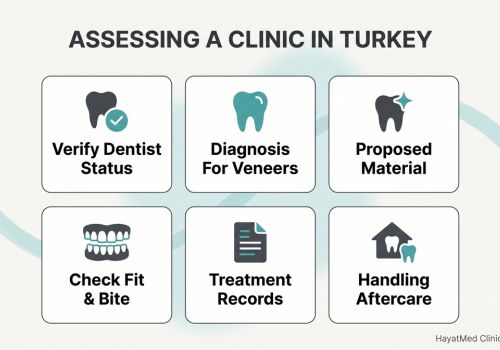
A useful clinic decision focuses on verifiable clinical and follow-up information rather than marketing labels.
Before booking, ask:
- who will perform the examination, preparation and bonding and how their professional status can be verified;
- what diagnosis supports veneers rather than another option;
- what material is proposed and why it suits your case;
- whether treatment could become more extensive after the in-person examination;
- how the clinic checks fit, bite and gum health before treatment is considered complete;
- what written consent, treatment records and aftercare instructions you will receive;
- how questions or complications are handled after you return home.
Location, photographs, package wording and advertised materials can help you compare services, but they do not establish that veneers are clinically appropriate for a particular patient.
What should you check about veneer costs and packages?
Cost is part of the decision, but this root treatment guide does not duplicate the detailed Turkey pricing role. A useful written quote should make clear the number of teeth, material, clinical work included, diagnostic or laboratory items, temporary restorations if relevant, follow-up, exclusions and the conditions attached to any aftercare or warranty wording.
Compare like with like rather than using only a headline package price. If the treatment plan changes after examination, ask how that affects the quote before irreversible treatment begins.
For current Turkey price ranges, package interpretation and quote comparison, use HayatMed’s Veneers Cost in Turkey guide.
What should you expect after treatment?
You should leave treatment knowing how to clean around the veneers, what changes in bite or comfort need review, and who to contact if a veneer chips, cracks, loosens or feels wrong. Routine oral hygiene and continuing dental care remain important because veneers do not protect the underlying teeth or gums from future dental disease.
Veneers themselves are not permanent for life even though the tooth preparation may be irreversible. Repair or replacement can be needed over time. For the deeper lifespan and replacement decision, see HayatMed’s are veneers permanent guide.


Veneers Cost in Turkey 2026: Prices, Packages and Quote Guide
As of September 2026, current published Turkish price guides place ceramic veneers broadly around £150–£350 per tooth, while published composite

Are Veneers Permanent? What Patients Should Know
Veneers are not permanent in the sense of lasting forever. The long-term commitment comes from tooth preparation: when enamel is

Teeth Scaling Cost and Deep Dental Cleaning Options
Your dentist may recommend a deep cleaning, also known as teeth scaling and root planing, to treat gum pockets deeper