
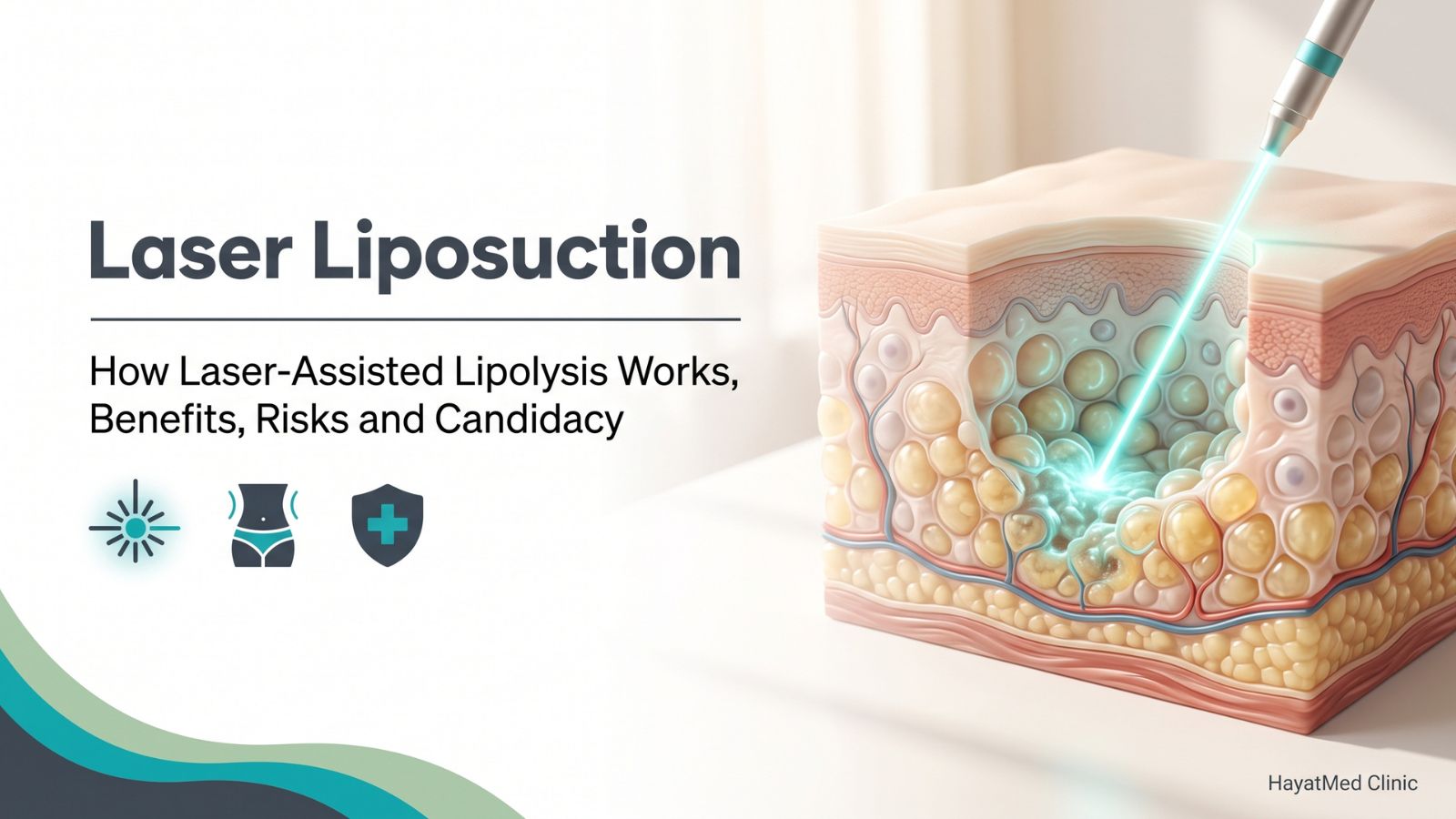
Laser liposuction is a surgical body-contouring procedure that uses a thin laser fibre beneath the skin before fat is removed by suction. It treats localised fat deposits, while the laser’s heat may also contribute to some tissue contraction.
Laser liposuction at HayatMed in Istanbul starts from €2,800. Our package includes surgery, one hospital night, six hotel nights and follow-up care, for a planned seven-night stay. Patients normally fly home after their final check at the end of that stay, provided they are fit to travel.
The NHS advises avoiding flying for five to seven days after liposuction. Our seven-night itinerary allows for this minimum interval, but flight fitness is assessed individually.
What Does Surgical Laser Treatment Involve?
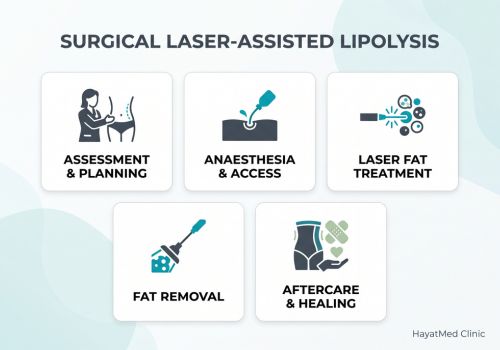
Surgical laser-assisted lipolysis uses a small incision, a laser fibre beneath the skin and a suction cannula to remove treated fat. Terms such as “lipo laser treatment” and “laser lipolysis” can also refer to external, non-invasive fat-reduction treatments. Those treatments use neither incisions nor suction and have different contouring and recovery expectations.
The usual treatment sequence is:
- Assessment and planning. Our surgeons assess the fat deposits, skin quality, health history and contour you want to achieve.
- Anaesthesia and access. The clinical team uses the planned anaesthesia and makes a small incision to access the treatment area.
- Laser-assisted fat treatment. A thin fibre delivers controlled heat to the targeted tissue, helping disrupt fat before removal.
- Fat removal and aftercare. A cannula removes the treated fat by suction. Compression and postoperative checks support the healing plan.
Local anaesthesia, sedation or general anaesthesia may be appropriate, depending on treatment extent and the clinical setting. The NHS describes general liposuction as typically taking around one to three hours, although the duration depends on the procedure’s extent.
Who Benefits From Laser Body Contouring?
Laser body contouring may suit someone near a stable weight with localised subcutaneous fat, reasonably elastic skin and realistic contour goals. It is a body-shaping treatment rather than a treatment for obesity or significant weight loss.
The assessment also considers previous surgery, scarring, smoking or nicotine use, medicines, supplements and general health. Substantial loose skin can limit the visible result after fat removal and may call for a different surgical approach.
Our surgeons select the technique according to the treatment area and the expected contour change, not simply the device name. The broader liposuction treatment guide explains the surgical options and general candidacy.
Laser Liposuction Results and Skin Tightening
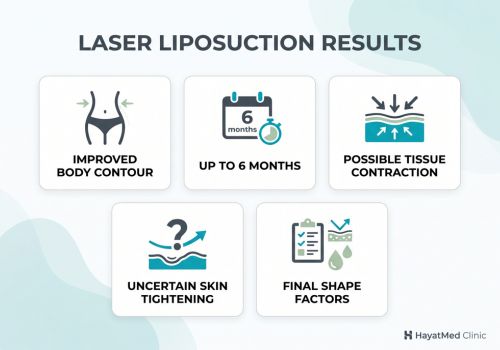
Laser liposuction results are changes in body contour after localised fat is removed, with the shape becoming clearer as swelling settles. Visible results develop over the following months and can take around six months to become fully apparent.
Laser energy may also cause some contraction of the surrounding tissue. However, the degree of visible skin tightening is uncertain, especially when there is significant excess skin. A systematic review of skin-retraction technologies found substantial differences between studies and a significant risk of bias.
Potential benefits include controlled treatment of localised fat and a possible additional tissue-contraction effect in selected patients. Final shape depends on fat distribution, skin elasticity, the amount removed and the operative plan.
Laser-Assisted vs Conventional vs VASER Liposuction
Laser-assisted, conventional and VASER liposuction all remove subcutaneous fat, but the way they prepare tissue differs.
Method How fat is treated and removed Possible tissue effect Key consideration
Laser-assisted liposuction Laser heat acts on fat beneath the skin, followed by cannula suction Heat may contribute to contraction, with variable visible benefit Adds a risk of thermal injury
Conventional liposuction A cannula mechanically loosens and suctions fat, without laser energy Skin response depends on the patient’s own tissues No laser-specific thermal risk
VASER liposuction Ultrasound energy assists treatment before suction removes fat Tissue response depends on the surgical plan Uses ultrasound rather than laser energy
A systematic review comparing laser-assisted and traditional liposuction found limited high-quality comparative evidence. This means technique selection should reflect anatomy, skin quality, treatment extent and the surgeon’s judgement.
For detailed ultrasound-specific planning, see our VASER liposuction guide. Conventional liposuction at HayatMed starts from €2,800, compared with €3,200 for VASER; Lipo 360 starts from €3,500. These are different treatment categories and scopes, not automatic upgrades.
How Much Does Laser Lipo Cost in Turkey?
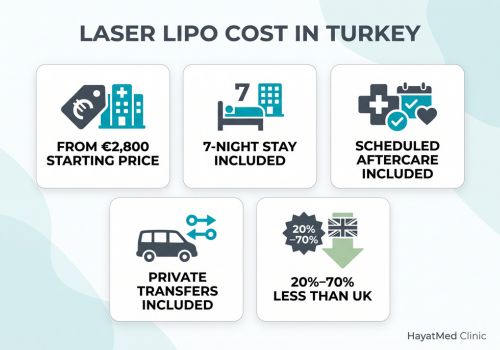
Laser liposuction at HayatMed in Istanbul starts from €2,800, including the operation, a planned seven-night stay and scheduled aftercare. The final procedure plan depends on the areas treated and whether any additional procedure is needed.
A September 2026 Turkish laser-liposuction directory estimate was $1,200–$4,400. This is a broad market range covering different areas, devices and package contents, not an equivalent seven-night hospital-and-hotel package.
For international context, the NHS quotes approximately £3,000–£8,500 for liposuction in the UK generally. The American Society of Plastic Surgeons’ 2024 figures put US surgeon fees at $4,300–$7,500, excluding hospital and anaesthesia charges. Neither benchmark describes an identical laser-assisted package.
Typically about 20–70% less than the UK liposuction price range the NHS gives (£3,000–£8,500). In the US, our price is about 25–55% less than the surgeon’s fee alone ($4,300–$7,500, ASPS 2024), before hospital and anaesthesia costs. Our price also includes six hotel nights and private transfers. For a full breakdown of procedure and area-based costs, see our liposuction cost guide.
What Is Included in the €2,800 Starting Package?
Our laser liposuction package in Istanbul combines surgery, accommodation, transport and aftercare in one treatment plan.
Package element HayatMed inclusion
Medical care Surgery, hospital or facility care, anaesthesia, pre-operative diagnostics and postoperative medicines
Hospital and hotel One hospital night and six hotel nights, seven nights in Istanbul in total
Follow-up Scheduled doctor check-ups and 12 months of remote follow-up
Transfers and support Private airport, hospital and hotel transfers; English-speaking assistant; 24/7 on-call support
When applicable Compression garment and lymphatic massage
International flights, travel insurance, extra hotel nights, revision surgery and additional procedures are not included. Our surgery takes place in a JCI-accredited partner hospital in Istanbul.
Laser Liposuction Recovery: Week by Week
Laser liposuction recovery usually begins with early gentle walking and several weeks of swelling, bruising, soreness or temporary numbness. Desk-based work may be possible within days for some patients, while more extensive treatment requires longer recovery.
Period What patients can typically expect
First few days Rest, gentle walking, wound care and swelling or bruising; follow the individual compression plan
Following days and weeks Swelling and tenderness continue to settle; light daily activities and some desk work may resume as tolerated
Around weeks 3–4 Gentle exercise may resume, following the clinical recovery plan
Around weeks 10–12 More strenuous exercise may be resumed if recovery is progressing appropriately
Following months, up to around six months The treated contour becomes clearer as remaining swelling resolves
These milestones follow general NHS liposuction guidance and ASPS assisted-liposuction recovery guidance, rather than a guaranteed laser-specific timetable. Compression garments or bandages are commonly used for several weeks. Our liposuction recovery guide covers activity, compression and longer-term healing in greater depth.
When Can You Fly Home After Laser Lipo?
Patients having laser liposuction at HayatMed in Istanbul normally fly after their final check at the end of a seven-night stay. The itinerary includes one hospital night and six hotel nights, with individual assessment of travel fitness.
The NHS advises no flying for five to seven days after liposuction because surgery and travel can increase blood-clot risk. A seven-night booking is a practical starting itinerary, not automatic clearance to board a flight. An extra hotel stay may be needed if recovery or the final assessment calls for it, and extra nights are at the patient’s cost.
What Are the Risks and Side Effects of Laser Lipo?
Laser liposuction commonly causes temporary swelling, bruising, discomfort and altered skin sensation, while significant complications can include infection, bleeding, fluid collection and tissue injury. Laser-generated heat adds a specific risk of burns or damage to skin and deeper tissue.
Other recognised surgical risks include anaesthesia complications, scars, asymmetry, contour irregularities and blood clots. Complications reviews describe burns, seromas, haematomas and infections across technology-assisted liposuction, without establishing a reliable laser-specific complication rate. The technique therefore needs careful patient selection and controlled use of energy.
Warning sign after surgery What to do
Painful or swollen leg, especially on one side Seek urgent same-day medical assessment for a possible blood clot
Sudden chest pain, severe breathlessness or collapse Call emergency medical services immediately; these may be signs of pulmonary embolism
Fever, a spreading red or hot wound, pus, worsening discharge or wound separation Contact the surgical team immediately for clinical assessment
Brisk or uncontrolled bleeding Seek urgent medical attention
How Our Istanbul Team Plans Surgery
Our plastic surgery team has more than 13 years of experience and has performed more than 7,000 procedures. We plan each operation around the patient’s fat distribution, skin quality, health and intended contour.
Our surgeons explain the expected changes, the limits of laser-related tissue contraction and the recovery plan for the areas being treated. Our team also arranges the seven-night Istanbul itinerary, scheduled reviews and year-long remote follow-up.


