

Yes, a tummy tuck and BBL can sometimes be planned in one operation, but same-session surgery is not automatically the better choice. The key decision is whether the added surgical scope, anaesthesia time, blood-clot risk, mobility demands and conflicting recovery positions are acceptable for you.
Staging may be preferred when one operation would be too long or demanding, when medical risk is higher, when donor-fat planning needs more flexibility, or when one result should settle before the second procedure.
A surgeon should compare both options using your health, abdominal repair needs, donor fat, body-contouring goals and recovery support. The goal is not to fit more surgery into one day. It is to choose a plan with a workable recovery and an acceptable risk profile.
Tummy tuck and BBL together vs staged: quick comparison
Plan Potential advantages Main trade-offs
Together in one operation One anaesthetic event and one overall recovery period; abdominal contouring and buttock shaping can be planned as one body-contouring strategy More surgery in one session, potentially longer operative time, more complex mobility and positioning, and both procedures’ risks must be managed at the same time
Staged in separate operations Each operation can be planned around a narrower surgical goal; the first result can be reassessed before the second procedure; recovery instructions may be easier to follow Two operations and two anaesthetic events; separate guidance places tummy-tuck work/exercise recovery at about 4 to 6 weeks and BBL return to exercise at about 6 to 8 weeks, while the interval between operations is individual
Neither option is automatically safer or better for every patient. The decision depends on the scale of each procedure, your medical risk profile, the surgeon’s expected operating time and whether the early recovery requirements can be followed safely.
What each procedure is trying to achieve
A tummy tuck removes excess abdominal skin and may tighten separated abdominal muscles. A Brazilian butt lift (BBL) uses liposuction to harvest fat and transfers selected fat into the buttocks to change shape or projection.
That difference matters. If your main concern is loose abdominal skin or muscle separation plus buttock volume, the decision is genuinely about combining two different operations. If the main goal is waist fat reduction rather than skin removal or muscle repair, a tummy tuck may not be the right comparison. The Lipo 360 vs BBL comparison explains the difference between circumferential fat removal and buttock fat transfer.
Can a tummy tuck and BBL be done at the same time?
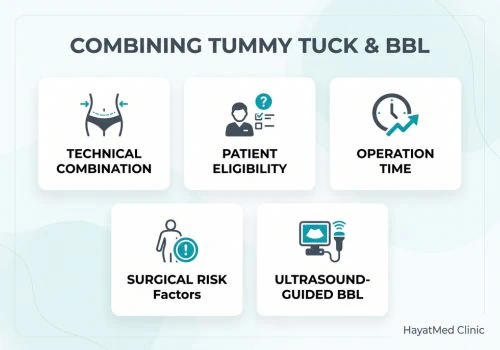
They can be combined in selected patients, but the fact that a combination is technically possible does not mean it is appropriate for a particular patient. A 2026 retrospective cohort specifically evaluated patients having BBL, liposuction and abdominoplasty in the same session, showing that the combination is performed in clinical practice. Its retrospective design does not establish that the combination is appropriate for every patient. Broader plastic-surgery data show that combined procedures and longer operative duration are associated with higher complication and venous-thromboembolism risk.
That is why the decision should be based on the whole operation rather than on the names of the procedures alone. A surgeon needs to consider how much liposuction is planned, whether abdominal muscle repair is required, the expected duration of surgery, your BMI and health history, previous operations, clotting risk, smoking status, mobility after surgery and the amount and location of donor fat.
BBL also has procedure-specific safety requirements. The ASPS joint safety statement on gluteal fat grafting supports keeping fat injection in the subcutaneous plane and using real-time ultrasound to help confirm cannula position. Those safety principles still matter when another operation is added.
Why can the recovery positions conflict?
The early recovery instructions for the two procedures can pull in different directions.
After a tummy tuck, patients are commonly kept slightly flexed at the waist to reduce tension on the abdominal repair. ASPS patient guidance describes staying bent at the waist while standing or lying down for about 7 to 10 days; your surgeon will confirm the exact plan for you.
After BBL fat grafting, pressure on the grafted buttocks is limited. ASPS buttock-enhancement recovery guidance advises avoiding prolonged sitting for about two weeks, with some surgeons preferring longer, and encourages sleeping face down or on the side; your surgeon will confirm the exact restrictions for you.
Those are separate-procedure reference points, not a combined recovery protocol. If both operations are planned together, the surgeon must create a positioning and mobility plan that protects the abdominal repair without placing avoidable pressure on the fat grafts.
How do surgical scope, anaesthesia time and blood-clot risk affect the decision?
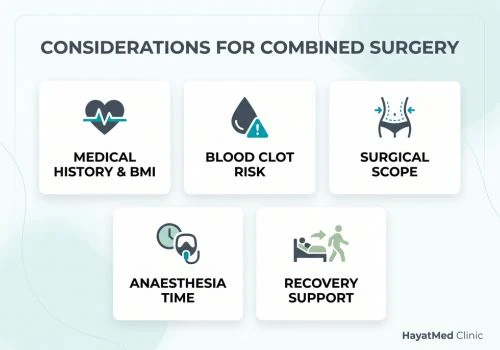
A combined operation usually means more surgical work in one session. Large observational studies in plastic surgery have found that combined procedures and longer operating or anaesthesia time are associated with a higher risk of venous thromboembolism and other complications. Abdominoplasty itself is one of the body-contouring procedures for which clot prevention and early mobility require careful planning.
This does not mean staging is automatically safer. Staging creates two separate operations and two anaesthetic exposures. The practical question is whether the risk and recovery burden of one larger operation is acceptable for you compared with two smaller operations.
Your surgeon may consider factors such as:
- personal or family history of blood clots;
- BMI and other medical conditions;
- smoking or nicotine use;
- medications and hormone treatment;
- expected operating time, anticipated blood loss and the number of areas being treated;
- how much liposuction and fat transfer are planned;
- the extent of abdominal skin removal or muscle repair;
- how soon you can mobilise after surgery;
- the support available during early recovery.
When might staging make more sense?
Staging may be considered when combining the procedures would make the operation too extensive, when a patient has risk factors that favour reducing the scope of one session, or when the recovery-positioning requirements would be difficult to reconcile.
It may also make sense when the surgical plan is not yet settled. For example, removing abdominal skin can change the waist-to-hip relationship, while liposuction and fat transfer can change the contour around the abdomen, flanks and buttocks. Completing one operation first can sometimes give the surgeon a clearer base for planning the second.
Staging is therefore a planning strategy, not a sign that one procedure has failed. The interval between operations should be individualised. No fixed HayatMed interval for staged tummy tuck and BBL is confirmed, so an exact waiting period should be set by the treating surgeon after reviewing healing and the next operative plan.
Which procedure should come first if they are staged?
There is no universal order.
The surgeon may discuss the tummy tuck first when abdominal skin removal or muscle repair is the dominant problem and the second-stage buttock plan can be refined after the abdomen heals. BBL may be discussed first when donor-fat availability, liposuction strategy or buttock contour is the main planning constraint.
The important point is that sequencing should preserve donor-fat options and avoid compromising the second operation. Ask the surgeon to explain what fat will be harvested, which areas must remain available for a later procedure, how the first operation changes the second plan and what milestone must be reached before another operation is considered.
How does recovery differ between one combined operation and two staged operations?
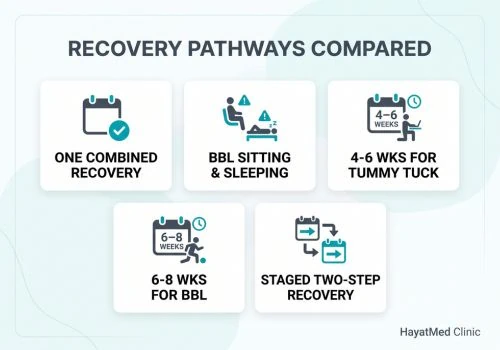
A combined operation can concentrate recovery into one overall period, but it does not make the restrictions disappear. You may have to follow the more demanding elements of both procedures at the same time.
For tummy tuck alone, the NHS advises about 4 to 6 weeks away from work and exercise; your surgeon will confirm when your own activities are safe. For BBL alone, ASPS guidance says exercise can generally resume after about 6 to 8 weeks; your surgeon will confirm when it is safe for you. These figures describe the procedures separately and should not be added together or used as a combined timetable.
With staged surgery, each operation has its own recovery. That can make positioning and day-to-day care simpler, but it also means returning for a second procedure and repeating the early recovery process.
For detailed BBL sitting, sleeping and activity restrictions, use the dedicated BBL recovery guidance rather than treating a combined-procedure decision as a full BBL recovery plan.
What should you ask your surgeon before combining the procedures?
A useful consultation should compare a combined plan with a staged plan for your anatomy and health rather than simply asking whether both operations can fit on the same day.
Ask:
- Why do you recommend combining or staging the procedures for me?
- What is the expected total operating time for the proposed plan?
- How will my blood-clot risk be assessed and reduced?
- How will I walk, rest and sleep without stressing the abdominal repair or the buttock fat grafts?
- Which areas will supply donor fat, and will the tummy tuck change those options?
- If the procedures are staged, which should come first and why?
- What finding during assessment would make you change from a combined plan to a staged plan?
- What help will I need during the first part of recovery?
If your goal is abdominal skin removal plus circumferential liposuction without buttock fat transfer, tummy tuck with Lipo 360 is a different decision and should not be treated as the same operation as tummy tuck plus BBL.
Is tummy tuck plus BBL the same as a mommy makeover?
Not necessarily. A mommy makeover is a broader planning concept that can combine abdominal surgery with breast surgery and other procedures according to postpartum changes and patient goals.
Tummy tuck plus BBL is a narrower two-procedure decision: abdominal skin or muscle correction plus buttock fat transfer. If breast surgery or a wider postpartum treatment plan is also central to your goals, the mommy-makeover framework may be more appropriate.
Planning the decision with HayatMed
HayatMed currently lists both BBL and tummy tuck as available treatments. That confirms treatment availability separately, but it does not establish that both are routinely performed in the same operation.
If you are considering both procedures, the useful next step is a surgeon-led assessment that compares a combined plan with a staged plan. The final recommendation should account for your health, abdominal repair needs, donor fat, expected operative scope, recovery support and the safest workable positioning strategy.


