
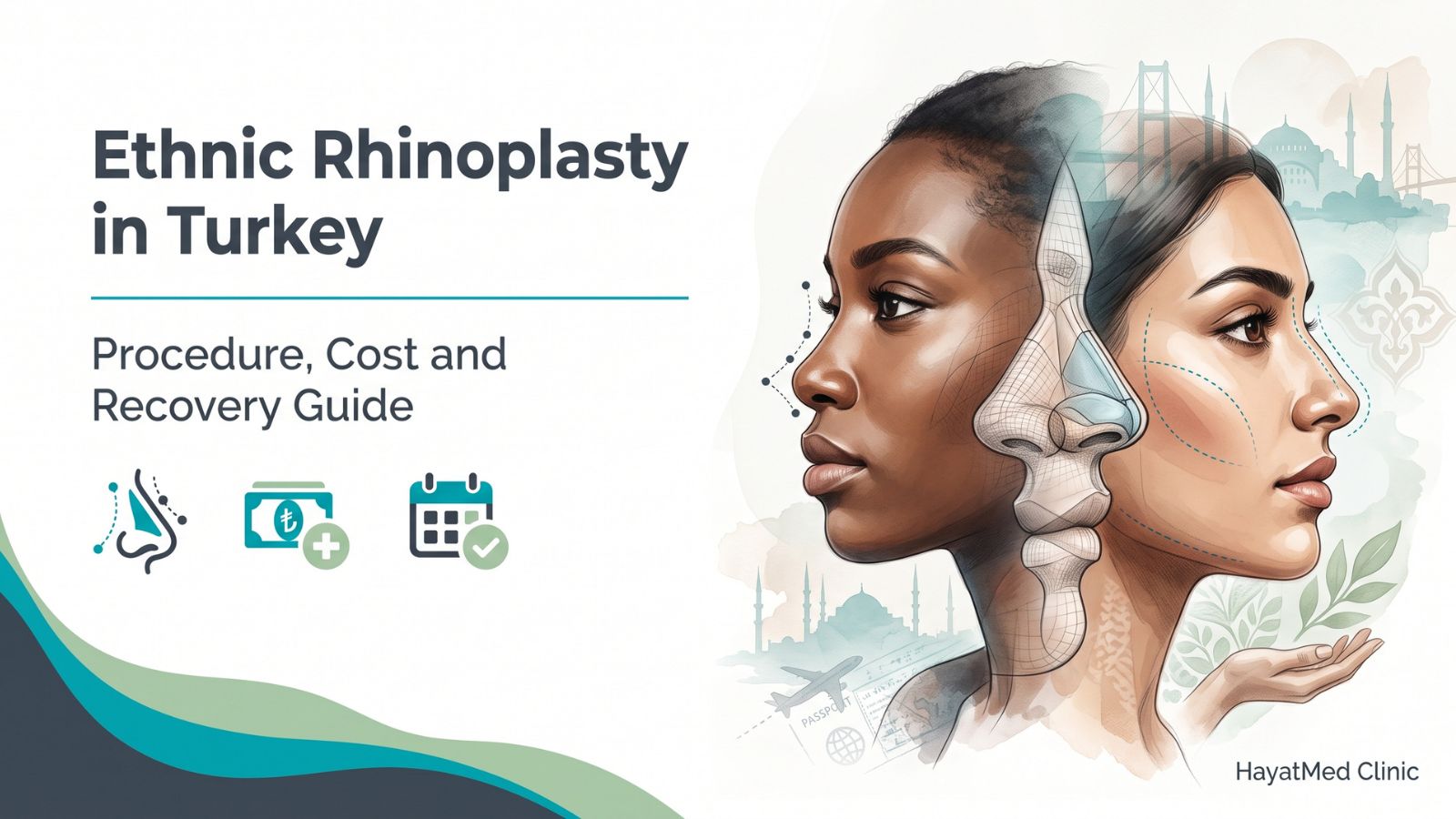
Ethnic rhinoplasty in Turkey reshapes the nose to suit your facial proportions, anatomy and identity. It can change the bridge, tip or nostrils, or address breathing problems, while keeping features you value. HayatMed’s standard rhinoplasty packages start from €3,400, with 5 hotel nights, usually 1 hospital night, and a typical Istanbul stay of 5–7 nights. Ethnic rhinoplasty requires an individual quote.
Ethnic rhinoplasty in Turkey, at a glance
- Planning: Decide which features you want changed or preserved. Surgery is planned around an examination, not ancestry.
- Recovery: Splint check around day 7; bruising often improves within 1–2 weeks; tip definition may take 6–12 months.
- Flying home: NHS guidance advises 7–10 days without flying after facial cosmetic surgery, or 2 weeks after septorhinoplasty in some hospital leaflets. A longer stay may be needed.
What Is Ethnic Nose Surgery?
Ethnic rhinoplasty makes your preferred appearance and the features you wish to keep part of the surgical plan. It is not one standard technique. People of the same ethnic background may have very different nasal anatomy.
Standard rhinoplasty can also be personalised. It can change appearance or address breathing problems, such as a deviated septum treated through septorhinoplasty. In ethnic rhinoplasty, you and your surgeon discuss which personal features should remain unchanged.
Planning question Conventional rhinoplasty Identity-preserving ethnic rhinoplasty
Main goal Reshape the nose or improve function according to the individual’s goals Reshape or improve function while explicitly identifying features the patient wants to retain
Bridge and tip May reduce, augment or support structures Same options, selected to fit anatomy, facial proportions and stated preferences
Skin and cartilage Skin thickness and cartilage strength always affect planning These characteristics are assessed individually, without predicting them from ethnic labels
Result Aims for a balanced, functional nose Aims for a balanced, functional nose that also reflects the patient’s chosen identity
A lower bridge, broad nasal base, thicker skin, prominent hump or less tip support can occur in many people. None is inherently a defect. A consultation helps identify useful changes and what surgery can safely achieve.
Thicker skin can hide small changes to the cartilage underneath. Tip definition may also take longer to appear. The approach to rhinoplasty for thick nasal skin depends on the examination, not an ethnic label.
Who Is a Good Candidate for Ethnic Rhinoplasty?
You may be a candidate if your nose has finished growing, your overall health is suitable and you have clear goals. You can also ask to preserve features important to your identity. If breathing is a concern, the surgeon should assess its cause rather than assume cosmetic surgery will help.
Cosmetic reasons
- Dissatisfaction with the bridge height, a prominent hump, tip definition, nostril width or facial balance.
- A wish for a more harmonious profile while keeping recognisable personal and heritage-related features.
Functional reasons
- Nasal blockage associated with a deviated septum or another medical reason for nose surgery.
- A possible combination of functional correction and cosmetic refinement where clinically appropriate.
General candidacy criteria typically include
- Nasal growth has finished; cosmetic surgery on a still-growing nose is generally avoided except for exceptional clinical circumstances.
- Overall health and any anaesthetic risks have been assessed.
- Expectations are realistic, and the patient is emotionally ready for a lasting change.
- The patient can describe both the changes they want and the features they do not want changed.
The American Society of Plastic Surgeons explains that rhinoplasty results refine over time. Photos and simulations cannot promise an exact shape.
Ethnic Rhinoplasty Techniques: Bridge, Tip and Nostrils
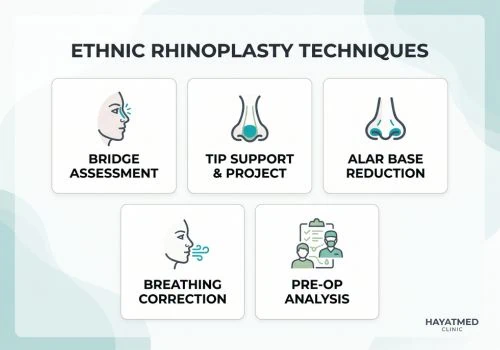
The surgeon checks the bridge, tip, nasal base, skin and airway to plan the operation.
- Bridge augmentation or hump reduction: A naturally low or flat bridge may be raised using cartilage from the septum, ear or rib when required; a prominent hump may instead be reduced. The choice depends on anatomy, goals and whether adequate structural support can be maintained. Anatomy-specific bridge choices are also discussed in Asian rhinoplasty.
- Tip support and projection: A bulbous, under-projected or drooping tip may be refined or supported with cartilage techniques. With thicker skin, an internal change may appear more subtle on the surface, particularly during swelling. For an isolated tip concern, tip plasty is a more focused option to assess.
- Alar base reduction: Selected patients may choose to adjust nostril flare or width through carefully placed incisions. Alar base reduction and its scar and breathing considerations deserve a distinct discussion because over-narrowing can change function as well as appearance.
- Breathing correction: When examination identifies a septal or other structural problem, functional treatment may be considered alongside external reshaping.
Open versus closed access
Both open and closed rhinoplasty approaches can be considered. A closed operation uses internal nostril incisions; an open operation adds a small incision at the columella and may provide access for complex structural work. Neither approach is automatically superior for a particular heritage or appearance goal.
Why anatomy matters more than ancestry labels
Thicker or oilier skin may swell for longer. Softer cartilage may need more support. Both affect surgical planning and healing, but neither automatically means a poor result.
Why Patients Choose Ethnic Rhinoplasty in Turkey
Patients consider Turkey for its surgeons, international patient services and prices. Before booking, verify the operating surgeon, licensed facility and aftercare arrangements.
The ISAPS Global Survey 2024 estimates 60,982 rhinoplasty procedures in Türkiye in 2024. This figure measures national procedure volume, not a specific clinic’s performance or the number of ethnic rhinoplasties.
Other reasons include lower operating costs than in some countries, experience with varied nasal anatomy, JCI-accredited partner hospitals and English-language coordination. Hospital accreditation does not guarantee a surgical outcome, and ISAPS membership is not specialist certification.
Ethnic Rhinoplasty Cost in Turkey
HayatMed’s standard rhinoplasty packages start from €3,400. Ethnic rhinoplasty needs a tailored quote. Rhinoplasty costs in Turkey depend on the procedure and what the package includes.
For context, the NHS lists UK private nose reshaping at £4,000–£7,000, before considering possible consultations, additional surgery and aftercare. Currency, complexity and inclusions make direct country comparisons imperfect.
What HayatMed includes
The standard rhinoplasty package covers surgery, facility care, anaesthesia, pre-operative tests, post-operative medication and scheduled examinations. It also includes 5 hotel nights, private airport, hospital and hotel transfers, and an English-speaking personal assistant. After returning home, patients receive 12 months of remote follow-up from the treating team and 24/7 on-call support. The usual hospital stay is 1 night; the typical total Istanbul stay is 5–7 nights.
Costs and package items to compare
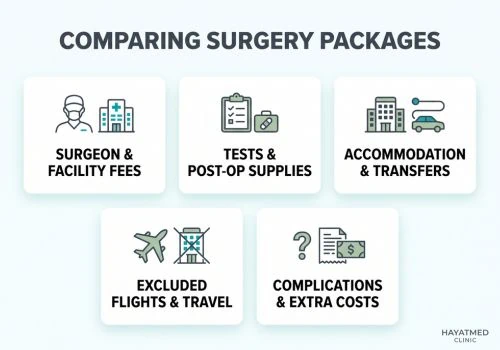
When comparing packages, check for:
- Surgery and surgeon’s fees, anaesthesia and hospital or clinic facility fees.
- Pre-operative assessment and tests, a nasal splint and post-operative supplies.
- Routine medications, dressings and follow-up visits during the stay.
- Accommodation and airport transfers, where included.
- Personal host or concierge services, and any compression or other support item if clinically indicated.
Possible extra charges include flights, travel insurance, extra hotel nights, revision surgery, additional procedures, extra investigations or imaging, medication beyond the basic kit, and complication-related costs. HayatMed excludes flights, travel insurance, extra hotel nights, revision surgery and additional procedures. Ask what a quote covers if complications or later revision care are needed.
Request an itemised quote showing surgeon and facility fees, tests, splint, medications, hotel nights, transfers, follow-up arrangements and possible extra costs. If a medical problem extends the stay, ask who coordinates care and which charges apply. The NHS guidance on surgery abroad also recommends planning aftercare and contingency arrangements before booking.
Ethnic Rhinoplasty Recovery Timeline
Bruising and early swelling usually improve during the first 1–2 weeks. Tip shape can keep changing for 6–12 months, sometimes up to a year. Healing is affected by skin, cartilage and the amount of surgery. See the rhinoplasty recovery timeline for more milestones.
- Days 1–3: Surgery commonly takes about 1.5–3 hours under general anaesthesia. Swelling and bruising may peak within 72 hours. Keep your head elevated and use medication prescribed for you.
- Week 1: Splint removal is commonly arranged around day 7. Bruising can remain for up to 2 weeks. The splint appointment is not automatic clearance for a flight.
- Weeks 2–3: A substantial proportion of visible swelling usually subsides and congestion can improve. Light desk work may become manageable, depending on comfort, duties and the surgeon’s advice.
- Weeks 4–6: More strenuous exercise may be possible after clearance; some NHS hospital guidance advises avoiding exercise and contact sports for 6 weeks.
- Months 3–12: Fine changes continue, particularly at the tip; final refinement may take 12 months or longer in some patients.
How long should I stay in Istanbul before flying?
HayatMed’s standard rhinoplasty stay is 5–7 nights, usually 5 hotel nights and 1 hospital night. This may be shorter than the recommended wait before flying. NHS Scotland advises avoiding flights for 7–10 days after facial cosmetic surgery. Cambridge University Hospitals advises avoiding flying for 2 weeks after septorhinoplasty. Obtain clearance from your surgeon and plan for extra nights if needed.
Ethnic Rhinoplasty Safety and Red Flags
Rhinoplasty carries risks even in a properly licensed hospital with an experienced surgeon. Issues can include bleeding, infection, anaesthetic complications, breathing problems, scarring, asymmetry, prolonged swelling or dissatisfaction requiring later assessment.
Common short-term effects
- Swelling and bruising that may peak in the first 72 hours.
- Congestion lasting several weeks and temporary numbness around the nose.
- Mild pain or discomfort, commonly managed with medication prescribed by the clinical team.
When to seek urgent medical advice
- Bleeding that does not stop after gentle pressure for 10–15 minutes, or heavy ongoing bleeding. NHS nosebleed first-aid guidance is general information; follow your operating team’s instructions after surgery.
- Fever, increasing redness or warmth, pus, or other signs of infection.
- Severe or worsening pain despite prescribed medication.
- Sudden difficulty breathing through one or both nostrils.
- Worsening one-sided swelling or redness, which requires urgent assessment for a possible septal haematoma.
What do published revision figures mean?
A 2017 review of rhinoplasty complications and reoperations reported reoperation rates of 2.73% for complete primary open rhinoplasty and 1.56% for complete primary closed rhinoplasty in the studied cases. These figures fall roughly within 1.5–3%. The review found no statistically significant difference between the techniques. These rates are not specific to ethnic rhinoplasty and cannot predict an individual patient’s outcome.
How to Choose an Ethnic Rhinoplasty Surgeon
Choose a surgeon who explains what will change, what will stay the same and how breathing may be affected. Your rhinoplasty treatment plan should cover appearance and airway function. Look beyond price: assess credentials, safety and follow-up. Use these rhinoplasty surgeon selection criteria during your consultation.
Experience with similar anatomy
Ask how many ethnic rhinoplasty cases the surgeon performs each year and request genuine before-and-after examples from patients whose starting anatomy resembles yours.
Clear surgical plan
Ask what changes are planned for the bridge, tip or nostrils, and why. Check whether cartilage grafts or breathing treatment are needed.
Board certification and memberships
Confirm the clinician’s actual specialty and professional registration through relevant Turkish registries. Turkish specialty qualifications, professional society membership and ISAPS membership are separate facts and should not be treated as interchangeable.
Facility accreditation
Verify the hospital’s Turkish Ministry of Health authorisation and any claimed JCI accreditation. Ask who will perform surgery and provide anaesthesia.
The facility should have documented infection-control procedures, patient monitoring and clear steps for managing complications. Ask how these work and who handles follow-up once you return home.
Aftercare plan for travellers
Confirm the in-person check, remote follow-up, emergency contact, availability of video visits and who will help if a complication occurs after returning home.
Revision policy
Ask about the clinic’s criteria and charges for any later revision rhinoplasty. Major revisions are commonly assessed only after substantial healing, often around 12 months, unless a complication requires earlier attention.
How to Evaluate Ethnic Rhinoplasty Results
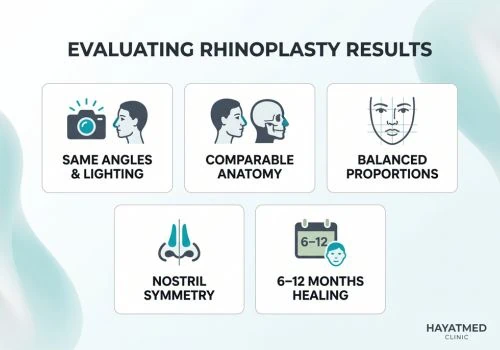
Before-and-after photographs can show whether a surgeon has experience with natural-looking results that respect patients’ preferences. They are examples, not promises of your result.
- Same angles and lighting: Compare like with like, including front, profile and base views.
- Comparable anatomy: Look for cases with similar initial nasal shape, skin thickness and tip structure.
- Balanced proportions: Assess the nose relative to the cheeks, lips and chin, not just whether it appears smaller.
- Nostril symmetry: Check the front and base views without expecting perfect symmetry.
- Healing stage: Ask whether the photographs were taken at least 6–12 months after surgery.
- Authenticity: Confirm that the photos show the treating surgeon’s own consenting patients, not stock examples.
A useful consultation question is: Which features of my current nose will you leave unchanged, and what trade-offs might be needed to protect breathing or maintain support?


